HectorMulti-Tenant Enterprise Operations Platform
A full-stack internal operations platform powering multi-brand e-commerce — from 11 sales channels through warehouse, supply chain, HR, and analytics in one system.
Business Context
Problem, approach, and outcome at a glance
The Challenge
A multi-brand e-commerce operation was running orders, inventory, procurement, fulfillment, returns, and HR across disconnected tools — manual handoffs, duplicate data entry, and no single source of truth under heavy transactional load.
The Solution
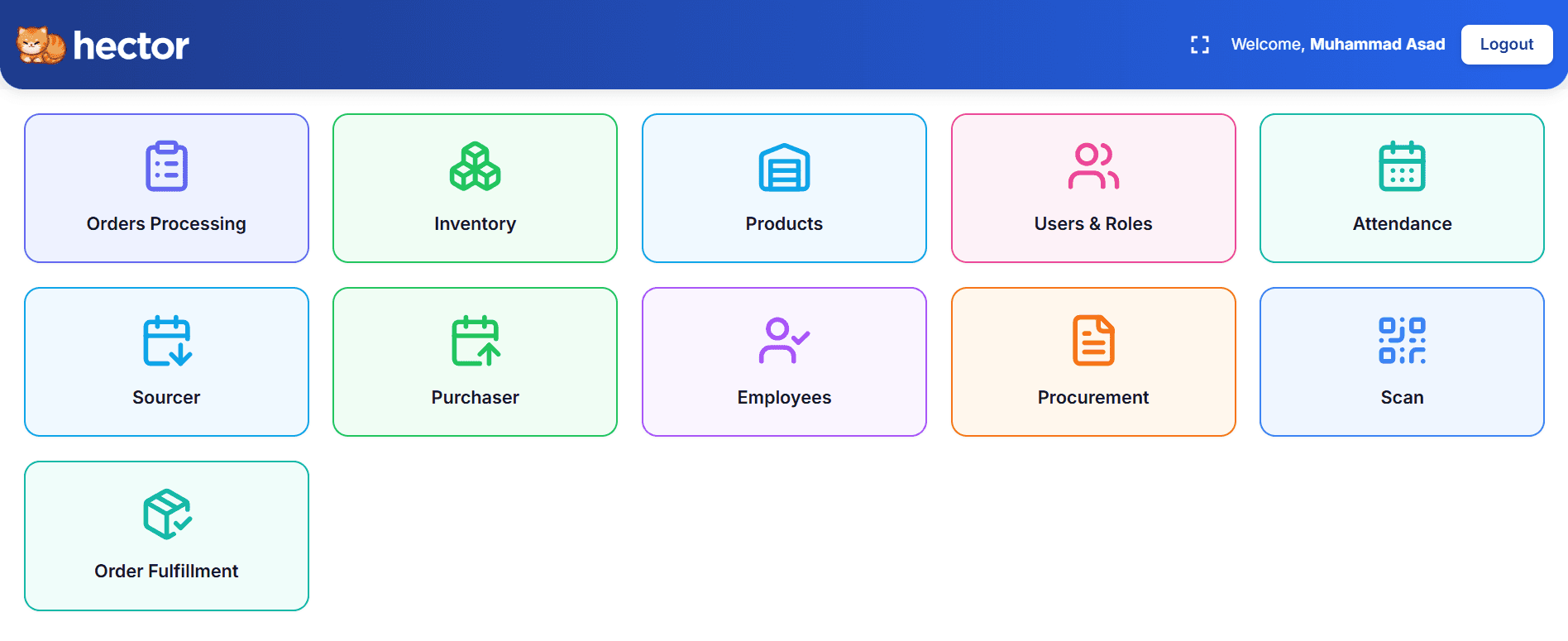
Hector unifies the entire operational lifecycle in one platform: order intake from 11 channels, warehouse fulfillment with hardware integrations, supply chain procurement, inventory (dual-system migration), post-sale workflows, analytics, and granular RBAC across every module.
The Impact
One system replaces fragmented ops tooling — with async SSOT aggregation, silent label printing on the warehouse floor, real-time auctions and SLA alerts, and multi-warehouse scoping baked into procurement, transfers, and QA from day one.
11 Sales Channels
Unified order intake pipeline
7 Business Domains · 28+ Modules
Expand each domain to explore the full module breakdown
Order Processing
Central hub ingesting orders from 11 channels simultaneously — Shopify (RetroFam & Retro vGames), Walmart US/CA/MX, WooCommerce, Newegg, Temu, Amazon SP-API, eBay Scrapper, Mercari CSV, and manual orders.
- WFO — Walmart Fulfillment with USB scale integration via SerialPort and ShipStation rate shopping
- TOF — Temu native label system with PDF rendering and label history
- Dedicated Amazon order processing view and order analytics dashboard
Order Fulfillment + SSOT
Post-pick workflow: packing with photo capture, dropship OOS tracking, ShipStation label generation, and SSOT — a pre-computed aggregate per order updated via BullMQ.
- Performance & activity logs for fulfillment teams
- Multi-carrier rate shopping through ShipStation
eBay Scrapper
Separate from marketplace eBay — manages buyer accounts, generates labels via EasyPost, tracks shipments via webhooks, with dedicated health check routes.
Key Architecture Decisions
Patterns that make Hector production-grade
Separate Frontend & Backend Repos
Hector-client (React 19 + Vite) and the Hector server (Node.js/Express) are maintained as separate repositories — clear ownership boundaries with REST APIs and shared domain contracts connecting both codebases.
JWT + Granular RBAC
Authentication via JWT + express-session. RequirePermission on the client and requirePermission() middleware on the server. Every module registers in modulesRegistry.js with configurable role permissions.
Eventually-Consistent SSOT
Single Source of Truth is a pre-computed master collection — updated asynchronously via BullMQ workers after fulfillment events. Never written to directly; always query-optimized.
Silent Warehouse Printing
QZ Tray signs certificates server-side (RSA) and sends labels directly to thermal printers — ShipStation, WFO, and TOF native labels print with zero browser dialogs.
Dual Inventory Migration
Legacy inventory coexists with the new Inventory Management module during migration. New features ship only in the new system; zero downtime cutover strategy.
Hardware + Real-Time Layer
DYMO USB scales communicate via Node.js SerialPort; weight telemetry streams to browsers over Socket.IO for WFO workflows. Multi-warehouse scoping across procurement, transfers, inventory, and QA.
20+ Third-Party Integrations
Marketplaces, shipping, hardware, queues, and more
Marketplace / Sales Channels
7 integrationsOrder sync, webhooks, refunds — RetroFam & Retro vGames
US/CA/MX orders, WFO labels, returns, tracking
Order sync, webhooks, returns, hold/cancel
Order sync, label tracking
Order sync, TOF native labels, after-sales
Order processing
Scrapper module labels and tracking
Core Technology Stack
Full Stack Engineer · Separate repos — React 19 + Vite frontend, Node.js/Express backend
Need an operations platform at this scale?
Hector represents the kind of enterprise infrastructure I design and ship — multi-channel order ops, warehouse integrations, and RBAC across dozens of modules.